Every year, the global music industry pauses to take stock of itself. Numbers are released, charts are analysed, and narratives are shaped. But beyond the headlines and percentages, the real story lies in what those numbers reveal – not just about growth, but about power.
The latest report from the International Federation of the Phonographic Industry paints a familiar picture: the global music industry continues to expand, driven largely by the dominance of streaming and the increasing fluidity of cross-border consumption. Music is travelling faster, further, and more seamlessly than ever before.
But for Africa, the question is no longer whether the world is listening.
It is whether the continent is building.
THE SOUND IS GLOBAL. THE STRUCTURE IS NOT.
Over the past decade, African music – particularly Afrobeats – has moved from regional dominance to global relevance. From Lagos to London, Accra to New York, the sound has embedded itself within mainstream culture, reshaping playlists, influencing pop production, and redefining what global music looks and feels like.
Yet, while the sound has scaled, the systems behind it remain uneven.
Streaming has made African music accessible, but accessibility does not always translate to ownership. The platforms that distribute the music, the structures that collect royalties, and the systems that determine value are still largely controlled outside the continent. This creates a fundamental imbalance: Africa is exporting culture at scale, but not always retaining the full economic value of that export.
STREAMING GROWTH VS ARTIST REALITY
The IFPI report continues to highlight streaming as the primary driver of global revenue. On paper, this is a win – more access, more listeners, more reach.
But for many African artists, the lived reality is more complex.
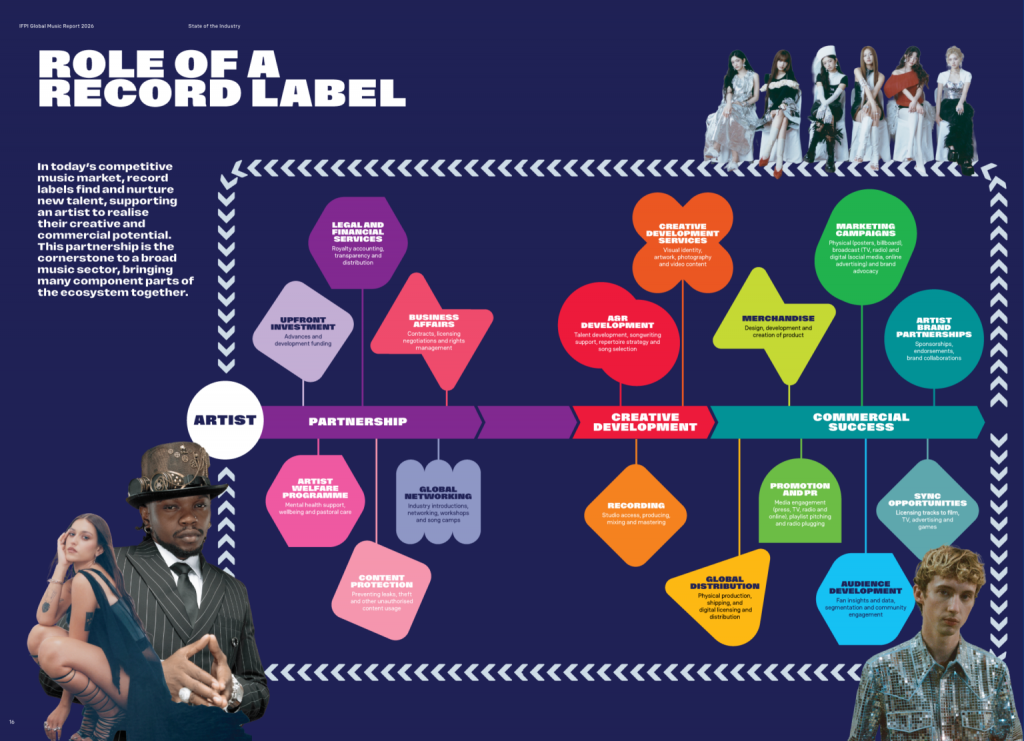
Revenue per stream remains low, and without strong publishing infrastructure, transparent royalty systems, and equitable deal structures, a significant portion of value generated from African music does not return to the creators or the ecosystems that birthed it.
As a result, artists often rely on alternative income streams – live performances, brand partnerships, and endorsements – to sustain their careers. The music itself, while globally consumed, does not always provide proportional financial return.
This is not just an economic issue.
It is a structural one.
BEYOND MOMENTS: THE NEED FOR INSTITUTIONS
If the IFPI report tells us anything, it is that the future of music will be defined not just by creativity, but by infrastructure.
For Africa, this means moving beyond moments of visibility into systems of sustainability.
The continent must continue to build:
• Publishing houses that protect and monetise songwriting
• Distribution systems that prioritise local ownership
• Royalty frameworks that ensure transparency and fairness
• Legal and policy structures that support long-term growth
• Archives that document and preserve cultural history
Because without these, growth remains fragile – dependent on external systems rather than internally sustained.
CULTURAL EXPORT OR CULTURAL OWNERSHIP?
African music today sits at a powerful intersection: it is both a cultural export and a global influence.
Collaborations with international artists are increasing. African sounds are being sampled, referenced, and reinterpreted across genres. The diaspora continues to act as a bridge between continents, accelerating the spread of the sound.
But as this expansion continues, a critical question emerges:
Who controls the narrative?
Ownership is not just about rights and royalties. It is about storytelling. It is about who defines the sound, who contextualises it, and who ultimately benefits from its global journey.
Without intentional structures, there is a risk that African music becomes globally consumed but externally defined.
FROM DATA TO DIRECTION
Reports like the IFPI Global Music Report provide valuable insight into where the industry is headed. But for Africa, the real value lies in how that data is interpreted and applied.
Growth alone is not enough.
The next phase of African music must be defined by:
• Ownership
• Structure
• Strategy
• Long-term thinking
It must be intentional about building systems that ensure that as the sound travels, the value remains connected to its source.
THE FUTURE IS NOT JUST GLOBAL – IT IS STRUCTURED
African music is no longer emerging. It is established. It is influential. It is global.
But the future will not be determined by how far the sound travels.
It will be determined by how well the continent builds around it.
At Music Custodian, we believe that documenting this moment is only part of the work. The real task is contributing to the systems that sustain it – ensuring that African music is not only heard around the world, but owned, protected, and understood within it.
Because if this is the era of global growth, then the next must be the era of African control.
The data shows growth.
The real question is whether Africa will convert that growth into ownership, structure, and lasting cultural power.
IFPI produces a range of resources and reports providing data and analysis on the current state of the global recording industry, the way we engage with music and the role and value of record labels.