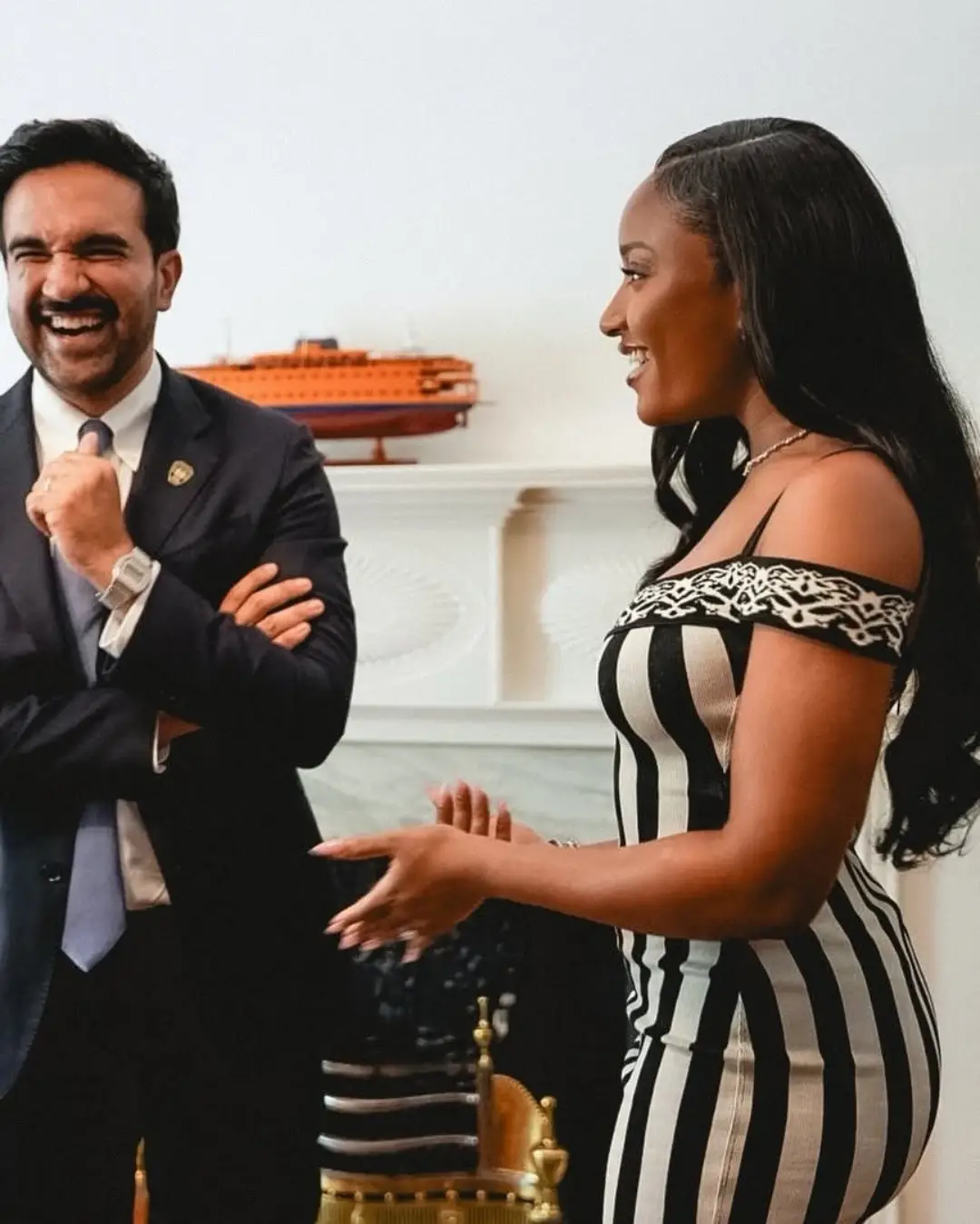
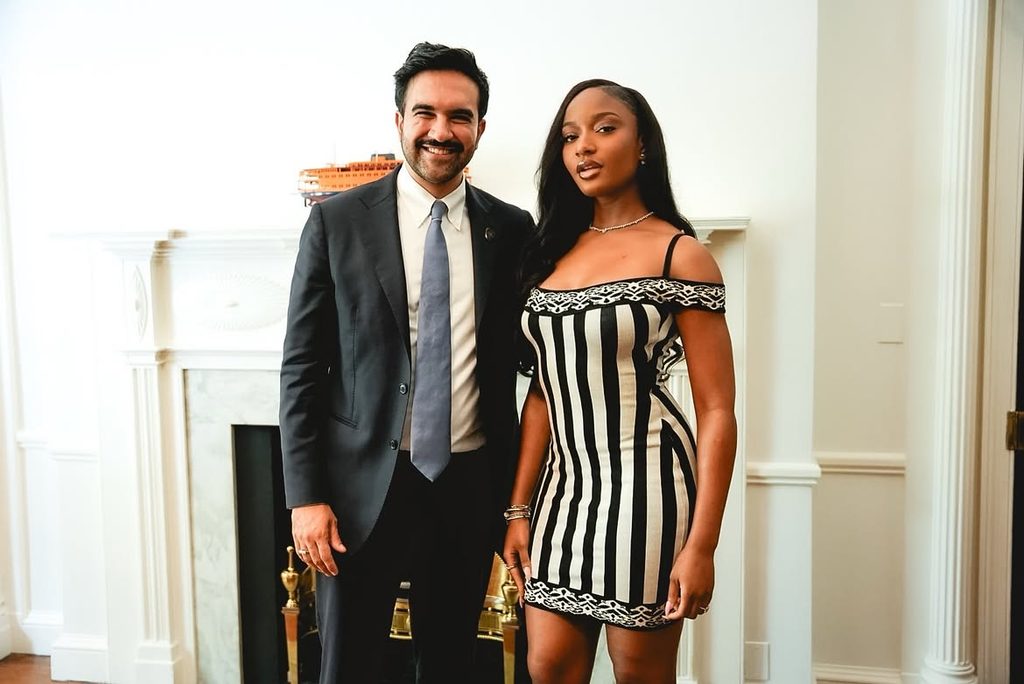
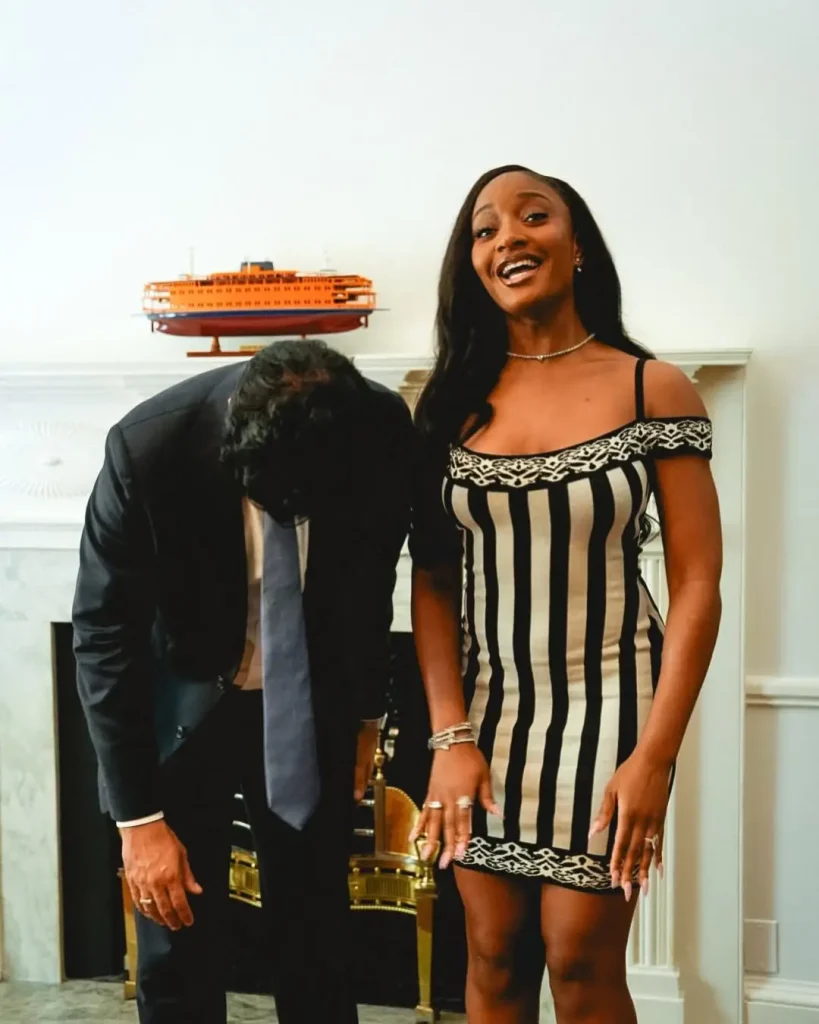
Nigerian pop star Ayra Starr linked up with New York City Mayor Zohran Mamdani, bringing together two young public figures whose careers occupy entirely different worlds but whose trajectories contain an intriguing point of convergence.
One became a global Nigerian pop star. The other became New York City’s first African-born, Muslim and South Asian mayor. Their meeting offers a small but resonant portrait of what African identity can become when it travels without disappearing.
A photograph between a musician and a politician can be nothing more than a photograph.
But sometimes the biographies standing inside the frame make it worth looking twice.
Nigerian pop star Ayra Starr linked up with New York City Mayor Zohran Mamdani, bringing together two young public figures whose careers occupy entirely different worlds but whose trajectories contain an intriguing point of convergence: both were born in Africa, both eventually carried their lives beyond the continent, and both have reached positions of global visibility without completely dissolving the identities that travelled with them.
One makes records.
The other makes policy.
One represents a generation helping reposition African pop within global popular culture. The other now governs one of the world’s most consequential cities.
Their experiences of race, migration and identity are not interchangeable. They shouldn’t be made so.
But the distance travelled by both is worth examining.
Ayra Starr’s journey began between places
Ayra Starr was born Oyinkansola Sarah Aderibigbe in Cotonou, Benin, to Nigerian parents and grew up between Cotonou and Lagos. She has spoken about how movement between cultures broadened the way she understood music and the world.
Her international success did not begin with an American record executive discovering her in Los Angeles.
It began much closer to home.
After posting music online, she was discovered by Don Jazzy and signed to Lagos-based Mavin Records. Her 2021 arrival eventually developed into an international career through records including “Bloody Samaritan” and “Rush,” the latter earning a Grammy nomination. Her 2024 album The Year I Turned 21 became the first album by a Nigerian female artist to debut on the Billboard 200.
By 2026, the geography of the career had expanded again.
Ayra told The FADER this August that she had moved into her own New York apartment in December 2025. Yet while discussing her new Starrgirl era, she was equally emphatic about the specificity she carried into that global life: Yoruba identity, Nigerian musical language and even the gele appearing within her visual world.
That distinction matters; Ayra’s globalization has not required her to become culturally anonymous.
Increasingly, the specificity is part of the proposition.

Mamdani travelled in another direction
Zohran Mamdani’s African story is radically different.
He was born in Kampala, Uganda, in 1991 to scholar Mahmood Mamdani and filmmaker Mira Nair. After part of his childhood in Cape Town, his family moved to New York when he was seven. He later became a US citizen in 2018.
On January 1, 2026, that child born in Kampala was sworn in as the 112th Mayor of New York City.
The milestone carried several histories simultaneously: Mamdani became New York’s first Muslim mayor, first mayor of South Asian descent and first mayor born in Africa. At 34, he was also the city’s youngest mayor in generations.
Those distinctions are not merely demographic trivia.
Mamdani grew up in post-9/11 New York as a Muslim, and his public career has unfolded within arguments about immigration, religion, belonging and what an American political leader is expected to look and sound like. He has spoken about once feeling as though he was perpetually a minority – Muslim in one context, a person of colour in another – before arriving at a more expansive understanding of what that perspective could mean.
There is another connection to culture that makes his meeting with Ayra particularly interesting.
Before elected politics, Mamdani made music.
As Young Cardamom, and later Mr. Cardamom, he pursued rap seriously enough to describe himself retrospectively as a minor rapper. His music incorporated South Asian identity, New York life and family; his 2019 song “Nani” honoured his grandmother.
So when Mamdani stands beside an African pop star, music isn’t entirely foreign territory.
He once attempted his own version of translating identity into sound.
Ayra simply took that proposition considerably further.
They are not the same minority story
This is where precision matters.
It would be tempting to look at Ayra Starr and Zohran Mamdani and write a broad inspirational story about “two minorities succeeding in America.”
That would flatten both of them.
Ayra’s experience as a Black African woman operating within the international music business carries histories around race, gender and the Western consumption of African culture that are particular to her.
Mamdani’s experience as an Indian-Ugandan Muslim immigrant operates through a different history – one involving South Asian diaspora, Islamophobia, migration and the complicated racial classifications applied to African-born people of Indian ancestry.
Indeed, Mamdani has explicitly rejected attempts to describe himself as Black or African American simply because he was born on the continent, instead describing himself as an American who was born in Africa.
The point isn’t that they are the same.
The point is that neither fits comfortably inside the old image of who gets to occupy the centre.
And yet there they are.
Two forms of soft power
There is another way to understand the photograph.
Ayra Starr represents cultural soft power.
Mamdani represents civic and political power.
African music’s global expansion has created a generation of artists who increasingly shape how millions of people encounter the continent. For a listener in Tokyo, São Paulo, Toronto or New York, an Ayra Starr record may constitute one of their most frequent interactions with contemporary African culture.
That carries influence.
Not governmental influence.
Something more diffuse.
Language travels.
Fashion travels.
Dance travels.
Yoruba travels.
Ideas about African femininity travel.
The possibility of a young African woman imagining herself as globally consequential travels too.
Ayra has been unusually conscious of this. Earlier in her career, she spoke about the double standards faced by women making music in Africa and her belief that younger women would eventually be able to express themselves with less criticism.
Mamdani’s power operates differently.
He now occupies an office from which decisions affect millions of residents of one of the most globally visible cities on Earth.
Yet his presence in that office also communicates something before any policy is enacted.
A Muslim.
A South Asian.
An immigrant.
A man born in Kampala.
Mayor of New York City.
Representation is not governance, and identity alone cannot determine whether a politician governs effectively. But representation can still alter the boundaries of political imagination.
In both careers, then, visibility becomes consequential.
Leaving Africa – without Africa leaving them
Perhaps “leaving Africa” requires qualification too.
Migration stories are often narrated as clean departures.
Someone leaves Africa.
They arrive in the West.
They succeed.
The West becomes the destination and Africa becomes the origin story.
Neither of these trajectories fits comfortably into that formula.
Ayra’s career was built through African infrastructure before becoming globally mobile: Nigerian label, Nigerian collaborators, African musical languages, Lagos as an early professional centre.
Even after establishing herself in New York, she continues to articulate her identity through those roots. Her latest music remains deliberately connected to Nigerian aesthetics and sounds while freely moving through R&B, pop and other global forms.
Mamdani left Uganda physically as a child, but Africa remained present through family, identity and intellectual formation. His father, Mahmood Mamdani, is one of Africa’s prominent scholars; his own college education was in Africana studies.
Neither story therefore needs to be interpreted as:
Africa → departure → Western success.
A more interesting formulation is:
Africa → movement → adaptation → contribution.
They brought something with them.
New York has always been built this way
And perhaps New York is precisely the city where such a meeting makes sense.
The city has long derived cultural power from people arriving with things that existed before New York knew them.
Languages.
Food.
Religion.
Rhythm.
Political ideas.
Fashion.
Memory.
Ambition.
Diasporas do not merely assimilate into cities.
They remake them.
That process is central to New York’s cultural history – including the history of music itself.
So there is something quietly fitting about an African-born Nigerian pop star meeting an African-born South Asian Muslim mayor there.
Neither represents Africa in its entirety.
Neither should carry that impossible burden.
But both demonstrate different possibilities for what African-born lives can contribute after crossing borders.
The photograph is small. The trajectories are not.
Music news often moves quickly.
An artist meets someone important.
Pictures circulate.
Timelines react.
Tomorrow produces another moment.
But Music Custodian should occasionally resist the speed of the feed long enough to ask what sits behind an image.
Behind Ayra Starr stands a young Black African woman who entered the music business through Lagos and has subsequently built a career capable of carrying Nigerian pop culture into some of the world’s largest cultural spaces.
Behind Zohran Mamdani stands a Kampala-born Indian-Ugandan Muslim whose family migrated through South Africa to the United States, and who eventually reached New York City Hall.
Different identities.
Different professions.
Different struggles.
Different kinds of power.
But there is something shared in the refusal of movement to require disappearance.
Migration can demand adaptation. Global industries can encourage assimilation. Minority identities can encounter prejudice, stereotyping and assumptions about where authority, beauty, intelligence or cultural importance are supposed to reside.
Yet sometimes people carry their difference all the way into the room.
Ayra Starr did it through music.
Zohran Mamdani did it through politics.
And somewhere in New York this week, those two journeys briefly occupied the same frame.
Perhaps that is the story worth keeping.
They left Africa for different reasons and at different moments. But neither had to leave everything African behind in order to matter to the world.