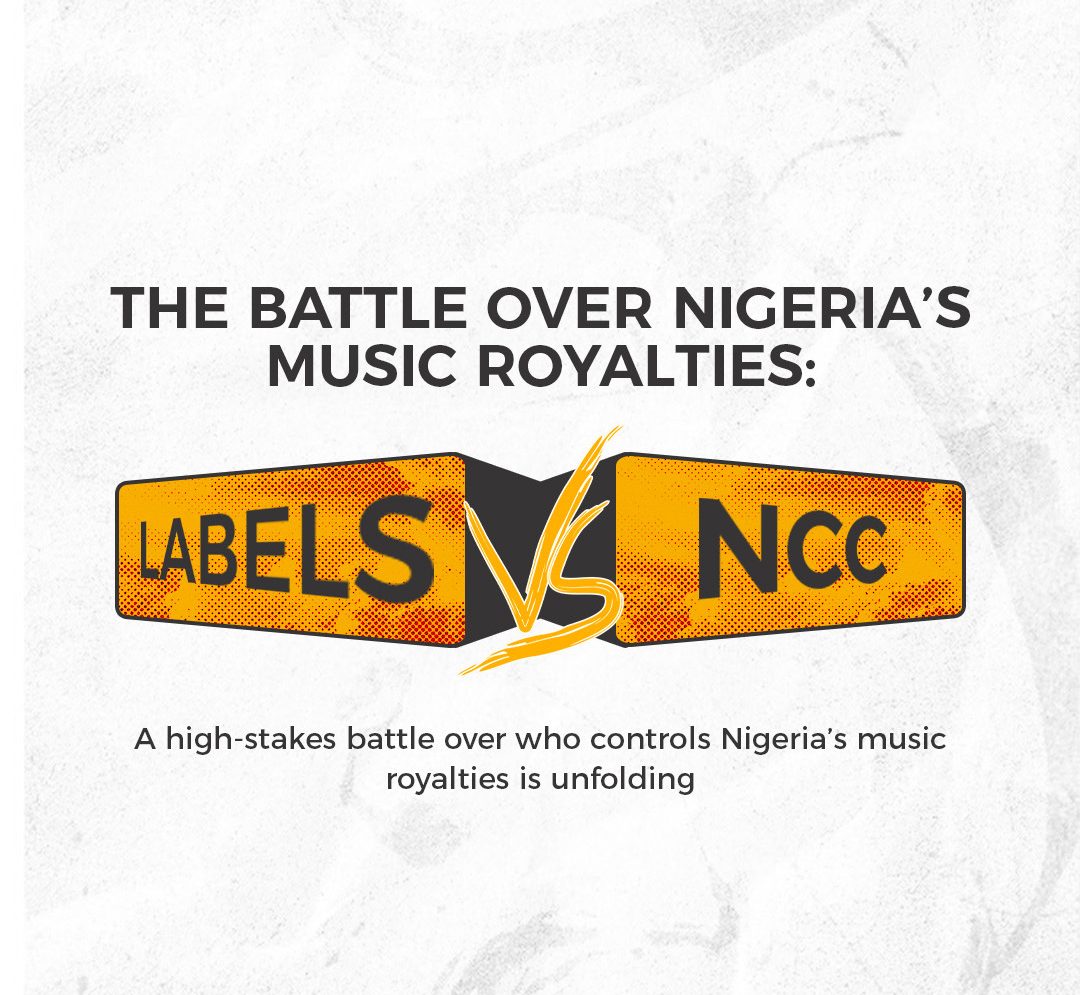
Nigeria’s music industry is once again at a critical crossroads—this time, not over charts, streams, or global recognition, but over who controls the money generated by the music record industry.
Behind closed doors, a high-stakes dispute is unfolding between the Record Label Proprietors Initiative Ltd/Gte (ReLPI) and the Nigerian Copyright Commission (NCC) over the proposed disbursement of Nigeria’s private copying levy—a fund designed to compensate rights holders for the informal use of their intellectual property.
At the center of the conflict is a fundamental question:
Who has the legal and moral authority to collect and distribute royalties on behalf of Nigeria’s sound recording owners?
What Sparked the Dispute?
In a formal letter dated January 21, 2026, ReLPI—Nigeria’s trade association for record labels—formally objected to the NCC’s plan to disburse the copyright levy through a Collective Management Organisation (CMO) that does not represent its members’ interests.
The letter, signed by ReLPI Chairman and Mavin Records CEO, Tega Oghenejobo, argues that the proposed framework fails to reflect standard global practice, particularly in how rights are classified, shared, and distributed among relevant stakeholders.
According to ReLPI, the current approach ignores the legal position of sound recording owners—despite their outsized contribution to Nigeria’s recorded music economy.
“The disbursement process does not align with accepted standards in the establishment of shares among the relevant classes of rights,” ReLPI stated in its correspondence to the Commission.
IFPI Enters the Conversation
The dispute quickly escalated beyond Nigeria’s borders.
In a separate letter dated January 22, 2026, the International Federation of the Phonographic Industry (IFPI)—the global body representing the recording industry worldwide—formally urged the NCC to halt the disbursement process.
The letter, signed by Angela Ndambuki, IFPI’s Regional Director for Sub-Saharan Africa, called for a process that is:
“Judicious, equitable, transparent, and protective of the interests of the right owners.”
IFPI warned that disbursing funds attributed to sound recordings to an entity without an unequivocal mandate from rights owners could result in irreversible prejudice to those owners. Crucially, IFPI emphasized that any collective management route must be based on explicit authorization rather than administrative convenience.
The Deeper Industry Context: A System Under Strain
This dispute did not emerge in a vacuum.
Nigeria’s collective management ecosystem has long been plagued by:
Leadership disputes
Legitimacy challenges
Fragmentation of representation
A persistent lack of trust from rights holders
These systemic failures directly contributed to the formation of ReLPI, which was created to represent the interests of both major and emerging record labels that believe existing CMOs do not adequately protect their investments.
What Exactly Is the Levy at the Center of This Fight?
The private copying levy (also referred to as the copyright levy) is a form of indirect compensation paid to rights holders for private uses of copyrighted works that cannot be practically licensed on an individual basis.
In simple terms, it recognizes a reality:
Music, films, and books are constantly copied, shared, stored, and repurposed—often informally and without direct licensing.
To account for this, the levy is attached to devices and materials capable of reproducing copyrighted content, including:
Mobile phones
USB flash drives
Hard drives
Computers
DVDs and recorders
Memory cards
Photocopying machines
Through this mechanism, the Nigerian government—via the NCC—seeks to compensate rights holders for widespread informal use of their intellectual property.
Who Is ReLPI and Why Their Position Matters
Record Label Proprietors Initiative Ltd/Gte (ReLPI) is a non-profit trade association representing owners of sound recordings in Nigeria.
Its membership includes some of the most powerful catalog owners in Nigerian music history, spanning recordings from the 1960s to the present day.
ReLPI members include:
Mavin Records
Chocolate City
Davido Music Worldwide (DMW)
Premier Records
Universal Music Group (UMG)
Sony Music Entertainment (SME)
Warner Music Group (WMG)
Hypertek Digital
Digital Music Commerce & Exchange (DMCE)
ReLPI is also formally recognised by the IFPI as the representative body for its Nigerian partner labels. The Musical Copyright Society of Nigeria Ltd/Gte (MCSN) is currently the only CMO approved by the NCC.
MCSN describes itself as:
“The only Collective Management Organization approved by the NCC to license, monitor, and distribute royalties for musical works and sound recordings in Nigeria.”
It claims over:
38,000 members
450,000+ tracked songs
₦1 billion in paid royalties
2,500+ licenses issued since 2022
However, ReLPI members have formally opted out of MCSN’s collective management structure.
ReLPI’s Legal Argument: Opting Out Is the Law
ReLPI’s position is grounded in the Copyright Act 2022, particularly:
Section 88(9b): Prevents a CMO from representing rights owners who are already represented by another body.
Section 89(3): Allows the NCC to disburse levy funds to approved CMOs or other representatives of rights owners.
ReLPI argues that:
It is a duly mandated representative of sound recording owners
MCSN does not have authority over ReLPI members’ works
The levy is not legally restricted to CMOs alone
In essence, ReLPI is not asking to bypass the law—it is asking for the law to be applied as written.
Why This Conversation Matters: Strengthening Public Awareness and Industry Accountability
At Music Custodian, our role goes beyond reporting headlines or reacting to controversy. Moments like this demand music industry literacy—the ability to understand how law, creativity, commerce, and power intersect within Nigeria’s music ecosystem.
This is not merely a disagreement between institutions. It is a public-interest issue that speaks directly to how value is recognised, protected, and distributed in Nigerian music culture.
At stake are:
Clear recognition of rights and roles across the music value chain
Transparent and accountable royalty governance
Effective coordination between regulators, rights owners, and representative bodies
Public understanding of how music generates value beyond streams and charts
Nigeria’s music economy cannot mature or compete sustainably on the global stage if its royalty systems remain opaque, contested, or poorly coordinated. Where governance lacks clarity, confidence erodes. Where confidence erodes,investment stalls, catalog value diminishes, and creators ultimately bear the cost.
By interrogating these issues openly, we aim to strengthen public awareness, encourage institutional accountability, and contribute to a more informed conversation about how Nigeria’s cultural assets are managed.
For us, royalty governance is not a technical footnote—it is core infrastructure. And infrastructure, when ignored, eventually collapses. And if Nigeria is serious about protecting its cultural capital, these questions cannot be swept aside in the name of administrative convenience.
As of the time of reporting, ReLPI maintains that the NCC is proceeding with plans to disburse the levy through MCSN.
If unresolved, this decision could set a precedent that reshapes:
How royalties are collected
Who controls rights administration?
How trust is built or broken within Nigeria’s music ecosystem
This is not just a legal battle. It is a defining test of governance in Nigerian music.
Music Custodian will continue to track this story—because industries are built on structure, not shortcuts.