As Tems earns recognition across R&B, African Music and Global Music categories at the 2027 Grammy Awards, the nominations also highlight the creative diversity of African musicians, the contributions of producers and songwriters, and the evolving place of African music within the international recording industry.
The nominations for the 69th Annual Grammy Awards have placed African music at the centre of another significant international conversation. Announced on November 16, 2026, the shortlist recognises an expansive group of African musicians whose work continues to reach audiences across geographical, linguistic and stylistic boundaries. Among them, Nigerian singer and songwriter Tems emerges as one of the most prominent figures, securing four nominations across three distinct Grammy fields.
Her recognition arrives alongside nominations for Angélique Kidjo, Ayra Starr, Davido, Asake, Wizkid, Burna Boy, King Ayisoba and Rocky Dawuni, reflecting a wider range of African musical expression than the Afrobeats-centred narratives that have often dominated international coverage.
For Tems, the four nominations represent another significant development in a career that has steadily challenged conventional expectations of what contemporary African popular music can sound like and where it belongs.

Yet the importance of this year’s nominations extends beyond individual achievement. They raise broader questions about how African music is categorised, how its creators are recognised and whether the international recording industry is developing a more expansive understanding of the continent’s musical contributions.
Tems and the Expanding Possibilities of African Artistry
Tems enters the 2027 Grammy Awards with four nominations: Best R&B Solo Performance and Best R&B Song for “What You Need”, Best African Music Performance for “Big Daddy”, and Best Global Music Album for Love Is A Kingdom.
The range of categories is especially noteworthy.
Rather than being recognised exclusively within classifications explicitly associated with African music, Tems appears in the R&B field alongside established international performers. “What You Need” competes for Best R&B Solo Performance against recordings by Beyoncé, Kehlani, Victoria Monét and Jill Scott.
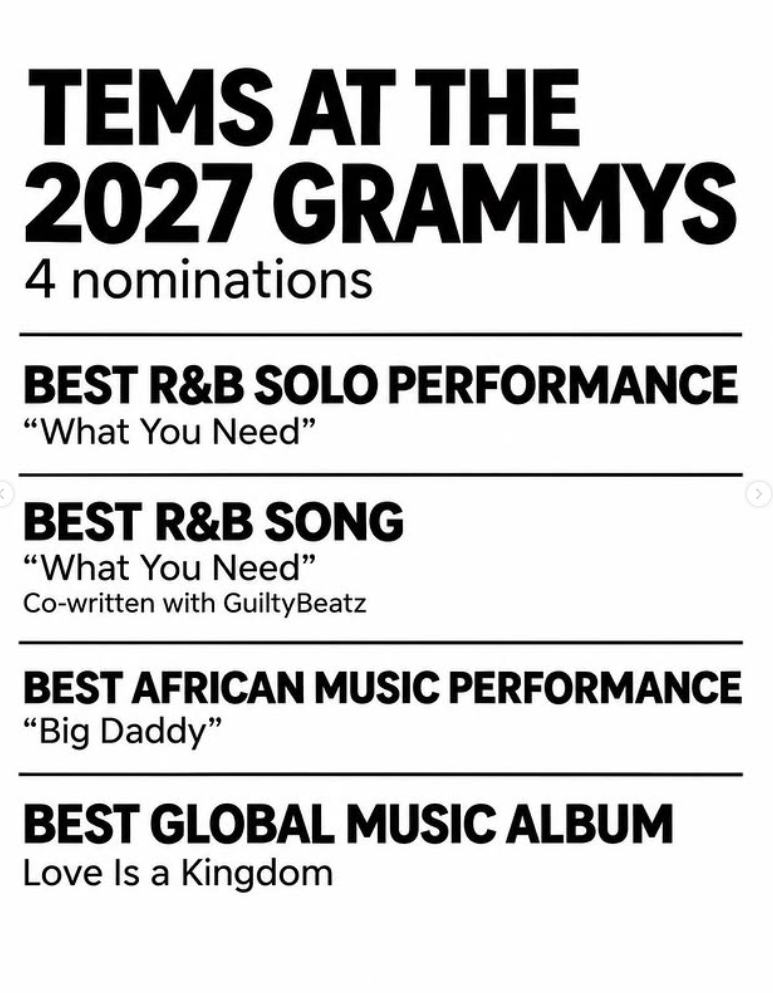
The song also appears in Best R&B Song, a category that recognises songwriting, with Tems and Ghanaian producer-songwriter GuiltyBeatz credited as its nominated writers.
These distinctions are important because they recognise different dimensions of musical creation. Performance categories acknowledge the recorded interpretation of a song, while songwriting categories place attention on the compositional work behind it.
For an artist whose appeal has long rested on an unmistakable vocal character, expressive restraint and an individual approach to melody, the R&B nominations represent recognition within a musical tradition that has influenced her work without fully defining it.
Tems’ development has never been confined to a single stylistic identity. Her recordings have drawn from R&B, alternative soul, Afropop and other contemporary influences, often favouring atmosphere and emotional expression over rigid genre conventions.
Her Grammy recognition reflects that versatility, but it also invites consideration of how audiences and institutions understand African artists who create music across multiple traditions.
The question is no longer simply whether African music can travel internationally. It is whether the diversity of that music can be understood without requiring every artist to fit within a narrow geographical or commercial category.
Four Nominations, Three Fields, One Distinctive Voice
The four nominations offer different perspectives on Tems’ creative identity.
“What You Need” receives recognition for both its performance and songwriting, with GuiltyBeatz sharing the latter nomination. “Big Daddy” places her within the Best African Music Performance category, while Love Is A Kingdom competes for Best Global Music Album.
Together, these nominations acknowledge an artist operating across musical contexts rather than remaining confined to one.
The recognition also continues an established Grammy relationship. Tems previously won Best Melodic Rap Performance for her contribution to Future’s “Wait for U”, featuring Drake, at the 2023 ceremony. She subsequently won Best African Music Performance for “Love Me JeJe” at the 2025 Grammy Awards.
Her 2027 nominations therefore form part of an ongoing career trajectory rather than an isolated breakthrough.
Nevertheless, nominations should not be mistaken for victories. The final awards will be decided through the Recording Academy’s voting process ahead of the February 7, 2027 ceremony.
For now, the achievement lies in the breadth of her recognition and the opportunities it creates for a more informed discussion of African musical identity.
GuiltyBeatz and the Importance of Recognising the Creators Behind the Music
Tems’ nomination for Best R&B Song also places Ghanaian producer and songwriter GuiltyBeatz within an important part of the story.
Credited alongside Tems for “What You Need”, GuiltyBeatz represents the collaborative creative labour that often receives less attention than the performers whose names appear prominently on recordings.
African music’s international expansion has depended on a growing network of producers, composers, engineers, instrumentalists, managers and other professionals who contribute to the development and circulation of recorded music.
Their work is essential to the sound, identity and commercial potential of the records reaching international audiences.
The Best R&B Song nomination provides an opportunity to recognise songwriting as a distinct creative contribution and to acknowledge the role African producers continue to play across contemporary popular music.
For Music Custodian, this distinction is particularly important. Documenting African music requires attention not only to its most visible performers but also to the individuals whose creative decisions shape the recordings themselves.
The story of African music’s global presence remains incomplete when those contributors are left out.
African Artists Claim Four of Five Best Global Music Album Nominations
One of the most striking developments in the 2027 nominations is the composition of the Best Global Music Album category.

Four of its five nominated albums are by African artists.
Davido receives recognition for Oriadé, Ayra Starr for Starrgirl, Angélique Kidjo for HOPE!!, and Tems for Love Is A Kingdom. Brazilian artist Anitta completes the category with EQUILIBRIVM.
The nominations bring together musicians representing different generations, artistic approaches and experiences of international recognition.
Angélique Kidjo has spent decades developing a career that connects African musical traditions with audiences and collaborators around the world. Her continued presence in international award conversations reflects an enduring body of work and the influence of an artist whose career predates the current global popularity of Afrobeats.
Davido represents a generation of Nigerian popular musicians who helped establish Afrobeats as an internationally recognised commercial force.
Ayra Starr belongs to a younger generation whose music circulates within an increasingly interconnected digital environment, where African artists can build audiences across continents without necessarily following older routes into international markets.
Tems, meanwhile, continues to demonstrate how a distinctive individual sound can operate across R&B, African popular music and broader global classifications.
Their presence in the same category illustrates the diversity of African music rather than the dominance of a single sound.
It also raises a longstanding question about the meaning of the Global Music classification itself.
While the category provides an avenue for recognising musical traditions and approaches that may not fit comfortably within other Grammy fields, the term remains broad enough to encompass artists whose work differs considerably in language, instrumentation, cultural context and commercial positioning.
The concentration of African nominees is noteworthy, but it should not obscure those differences.
African music is not one genre, and international recognition should not require it to be understood as one.
Best African Music Performance: A Wider Continental Conversation
The Best African Music Performance category offers another revealing picture of the continent’s musical landscape.
This year’s nominees are Asake for “Gratitude”; Angélique Kidjo and Ayra Starr for “Aye Kan (Are You Coming Back?)”; King Ayisoba featuring Rocky Dawuni for “No Tradition, No Africa”; Tems for “Big Daddy”; and Wizkid and Asake for “Jogodo”.
The shortlist includes artists associated with Nigerian contemporary popular music alongside musicians whose work draws from other African traditions and creative histories.
Ghanaian musician King Ayisoba, recognised for his work with the kologo, brings a different musical vocabulary to the category. His collaboration with Rocky Dawuni introduces another dimension to a field often discussed primarily through the international success of Nigerian Afrobeats.
The inclusion of Angélique Kidjo alongside Ayra Starr also reflects a relationship between generations of African musicians.
Such collaborations can create opportunities for younger audiences to encounter established artistic traditions while allowing experienced musicians to participate in new musical conversations.
Asake’s two appearances in the category, through “Gratitude” and his collaboration with Wizkid on “Jogodo”, further demonstrate the range of relationships and creative partnerships shaping contemporary Nigerian music.
The category’s diversity matters because the international visibility of Afrobeats, while significant, does not represent the entirety of African music.
Across the continent, musicians continue to develop distinctive forms of expression informed by local languages, inherited musical practices, experimentation and contemporary cultural experiences.
A meaningful assessment of African representation at the Grammys must make room for that wider landscape.
Burna Boy and the Recognition of African Music Beyond African Categories
Burna Boy’s appearance in Best Global Music Performance offers another example of African musicians participating in categories that connect different international musical traditions.
He is nominated alongside Shakira for “Dai Dai”, in a category that also includes Angélique Kidjo’s collaboration with Pharrell Williams and Quavo on “Bando [Orchestral]”.
These nominations reflect the continuing importance of international collaboration within contemporary music.
However, collaboration alone is not evidence of cultural equality or artistic influence. The more substantial question concerns the creative roles African musicians occupy within these recordings, the recognition they receive and the extent to which their contributions are understood beyond the appeal of their commercial profiles.
As African artists become increasingly visible in international recording projects, attention must also turn towards songwriting credits, production ownership, contractual participation and long-term professional opportunities.
Visibility is valuable, but the structures surrounding that visibility determine how its benefits are distributed.
Beyond Recognition: What the Nominations Mean for African Music
The 2027 Grammy nominations arrive during a period in which African music has become increasingly prominent within international popular culture.
Streaming services, social media platforms, touring networks and cross-border collaborations have expanded the ways in which music travels between African markets and audiences elsewhere.
Yet global visibility does not automatically translate into a stronger or more equitable music industry across the continent.
Questions surrounding royalties, publishing administration, performance infrastructure, intellectual property, professional training and sustainable artist development remain central to the long-term health of African music.
The nominations offer recognition of individual creative achievements. They do not, by themselves, resolve those structural challenges.
For emerging artists, producers and other music professionals, the most meaningful long-term outcome would be an environment in which international opportunities are supported by stronger institutions and more sustainable local ecosystems.
That requires investment not only in performers but also in the professionals and organisations responsible for developing, documenting, distributing and preserving African music.
It also requires a broader cultural conversation.
African musicians should be able to achieve international recognition without losing the artistic distinctions that make their work meaningful. Their success should not depend exclusively on conforming to the most commercially familiar interpretations of African popular music.
The range of this year’s nominees offers an opportunity to recognise that complexity.
The Grammy Awards Are a Milestone, Not the Final Measure
For all their international prestige, the Grammy Awards remain one institution within a much larger musical world.
Their nominations reflect the decisions of a voting membership operating within established eligibility requirements and award classifications. They should not be treated as a definitive ranking of African musical achievement.
Some of the continent’s most influential musicians have built lasting cultural legacies without receiving Grammy recognition. Others continue to shape local and regional music communities whose significance cannot be measured exclusively through international awards.
This perspective does not diminish the achievements of Tems, Angélique Kidjo, Davido, Ayra Starr, Asake, Wizkid, Burna Boy, King Ayisoba or Rocky Dawuni.
Instead, it places their recognition within a more complete understanding of African music’s value.
The Grammys can acknowledge musical excellence. They cannot independently determine its existence.
That distinction is particularly important at a time when international recognition is frequently presented as the ultimate validation of African creative work.
African music’s cultural significance has always extended beyond the institutions now celebrating it.
A Significant Moment, and a Larger Story Still Unfolding
Tems’ four nominations are an important achievement in their own right.
They recognise her work across multiple musical fields, affirm the contributions of collaborators such as GuiltyBeatz and add another chapter to a career distinguished by artistic individuality.
Alongside her, the wider group of African nominees reflects a continent whose musicians continue to participate in international music conversations through different languages, traditions, generations and creative approaches.
The 2027 Grammy Awards will determine which of these nominated recordings receive trophies. But the larger story is already visible in the nominations themselves.
African artists are contributing to the development of contemporary popular music in ways that extend well beyond the boundaries of Afrobeats or any single industry classification.
The responsibility now falls not only on international institutions to recognise that diversity, but also on African media, cultural organisations and music professionals to document it with the depth and seriousness it deserves.
For Tems and her fellow nominees, February 7 will bring another moment of anticipation.
For African music, the more important work continues long after the ceremony ends.